

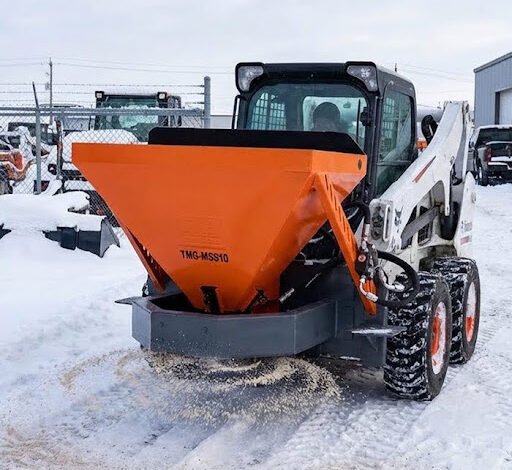
Property managers across the northern United States judge a winter site by how it looks at the start of a shift: lots open, walkways clear, and no slick patches. The machine that treats those surfaces matters less than how it is set up. A Tilt-N-Scoop material spreader on a skid steer has three controls that decide how much lands on the pavement, and knowing them is more useful than reading a spec sheet.
An Hourglass Explains the Gate
An hourglass is a useful picture. The sand runs at a steady rate set by the narrow opening, not by how much sits in the top bulb. A spreader works the same way, with the manual gate acting as the opening. A fuller hopper does not change what leaves each second, so a skid steer spreader can be set once and trusted through a whole fill.
Rate per second is only half the story, though. The amount landing on each square foot also depends on how fast the machine travels. Double the ground speed at the same gate setting and the material goes down half as thick. A short test pass at working speed, checked against the pavement behind, sets both together.
Hydraulic Flow Drives the Agitator, Not the Spread
Damp or lumpy material tends to bridge, forming an arch over the outlet while the hopper above it stays full. A steel agitator turned by a Permco hydraulic motor breaks that arch, and a protective grate keeps lumps and debris out of the outlet. Motor speed follows hydraulic flow, so the carrier should supply between 6.5 and 12 gallons per minute at 1,300 to 1,700 pounds per square inch. Too little flow lets the material bridge, and no gate setting can fix that, so check the auxiliary flow rating of the skid steer before choosing any attachment.
Scooping Turns Loading Into a Driving Task
The tilt and scoop design lets the operator fill the 10 cubic foot hopper by driving into a pile and tilting it back, without leaving the seat or reaching for a shovel. Loading becomes part of the same pass as spreading, so a skid steer spreader like this one can treat a lot early, instead of after ice has bonded to the surface and far more material is needed. Keep the hopper low while traveling, since a full load sits high and heavy at the front of the machine.
Narrowing the Spread Protects What Surrounds It
A removable sidewalk skirt narrows the pattern so material stays on the walkway instead of landing on lawns, plantings, or parked vehicles. With the skirt off, the spread reaches up to 30 feet, which suits open lots. Switching between the two takes only a few minutes, so one skid steer spreader can handle the main lane and the front steps in a single visit.
Rinse, Record, and Reduce
Salt and fertilizer corrode steel, so rinse the hopper, grate, and agitator after use and let everything dry before storage. Keep a simple record of gate setting, ground speed, and results, because the next storm is easier to treat from notes than from memory. Crews that track what an ice melt spreader puts down tend to use less, which saves cost and limits runoff. TMG Industrial lists the TMG-MSS10 for sites that want to apply material in a controlled, repeatable way.