
From Social Media to Smart Travel: How Digital Connectivity Shapes the Saudi Traveler Experience

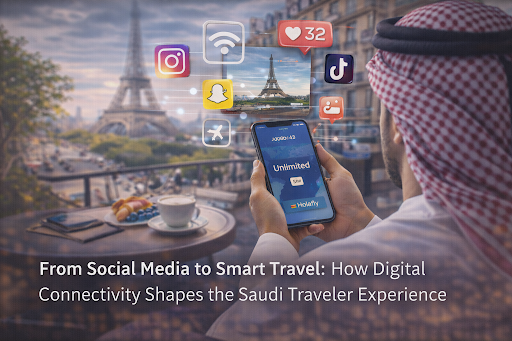
Travel has always been a way to explore new places, cultures, and perspectives. But for today’s Saudi travelers, it has also become something more: a digital experience that unfolds in real time across social media platforms, messaging apps, and online communities. The journey no longer begins at the airport—it starts on a smartphone screen.
From planning itineraries on travel apps to sharing live updates on Instagram, Snapchat, TikTok, and X, connectivity is now central to how Saudis travel, document, and even define their experiences abroad. In this always-online environment, digital access is not just a convenience—it’s infrastructure.
The Rise of the Always-Connected Traveler
Saudi Arabia has one of the highest social media engagement rates in the region. Young professionals, students, entrepreneurs, and families are deeply integrated into digital ecosystems. Travel, naturally, reflects that behavior.
Before departure, travelers research destinations through online reviews, short-form videos, and trending hashtags. Hotel bookings, restaurant reservations, and attraction tickets are handled via apps. Even airport navigation and boarding passes are fully digital.
Once abroad, the smartphone becomes the traveler’s control center. It serves as:
- A navigation system
- A translator
- A booking assistant
- A payment tool
- A camera and publishing platform
- A connection to family and business networks
In this context, being offline—even briefly—can feel disruptive.
Travel as Content Creation
For many Saudis, especially younger travelers, travel is no longer a private experience. It’s a shareable moment.
Stories are posted in real time. Cafés are tagged. City skylines are livestreamed. Cultural experiences are documented through short-form video. Even airport lounges and hotel rooms become part of a curated narrative.
This shift reflects a broader global trend: travel as digital storytelling. The destination matters—but so does how it is captured, edited, and shared.
Without stable internet access, this digital layer of travel becomes fragmented. Upload delays, failed posts, and limited data plans interrupt the flow of real-time sharing. For content-driven travelers, connectivity supports spontaneity.
The Practical Necessity Behind the Lifestyle
Beyond social sharing, constant connectivity also supports practical needs.
International travel requires quick access to information. Flight updates change. Ride-hailing apps depend on mobile data. Maps guide users through unfamiliar metro systems. Restaurant bookings often require app-based confirmation.
For business travelers, the stakes are even higher. Meetings may continue across time zones. Documents need to be downloaded. Email remains constant.
In an era where remote work is normalized, the boundary between “travel” and “professional life” is increasingly blurred.
Reliable mobile data enables:
- Video conferencing
- Secure access to cloud platforms
- Communication with teams
- Real-time collaboration
Connectivity has become part of professional readiness.
The Shift Toward Digital SIM Technology
Traditionally, travelers relied on international roaming or purchased local SIM cards upon arrival. Both options can create friction—either through high roaming costs or time spent locating a local provider in a new city.
As smartphone technology evolves, digital SIM (eSIM) solutions are increasingly reshaping this experience. Instead of swapping physical cards, users can activate a mobile data plan digitally before departure.
This reflects a broader move toward frictionless travel infrastructure—where preparation happens online and activation is instant.
As more Saudi travelers plan their trips digitally, many explore solutions like Holafly’s esim for travelers to ensure uninterrupted access to maps, messaging apps, and social platforms while abroad. Rather than adjusting their habits around data limits, users are prioritizing flexibility and convenience.
The emphasis is not necessarily on a brand—but on the growing expectation of seamless digital continuity.
Travel Identity in the Digital Age
There is also a cultural dimension to this transformation. Travel today is intertwined with digital identity.
The modern traveler does not simply visit a destination; they broadcast it. Their presence online extends into new geographies. Their digital footprint moves with them.
This phenomenon is particularly visible among Gulf travelers, who are active participants in global digital conversations. Whether commenting on international events, posting culinary discoveries, or sharing fashion inspiration from European capitals, connectivity enables cross-border engagement.
The smartphone becomes a bridge—not only between places, but between audiences.
Connectivity and Digital Security
As online activity increases, so does awareness of digital security. Public Wi-Fi networks in airports, cafés, and hotels are convenient but not always secure. For travelers managing financial transactions, accessing corporate platforms, or sharing sensitive information, stable mobile data connections offer an added layer of privacy.
This concern reflects another evolution in traveler behavior: digital risk awareness. Cybersecurity is no longer limited to corporate environments—it extends into personal travel habits.
Mobile data plans that reduce reliance on open Wi-Fi networks contribute to safer online activity while abroad.
The Future of Smart Travel
Looking ahead, digital connectivity will likely become even more embedded in the travel ecosystem.
Airports are investing in biometric boarding. Hotels are adopting mobile check-in systems. Translation tools powered by AI are becoming more advanced. Real-time language assistance and augmented reality navigation are expanding.
All of these innovations rely on constant data access.
For Saudi travelers—who are part of one of the region’s most digitally engaged populations—connectivity will remain a central component of mobility.
Travel is no longer defined only by movement between cities. It is defined by digital continuity.
Conclusion
From content creation to professional productivity, from navigation to social engagement, connectivity shapes nearly every dimension of modern travel.
Saudi travelers, deeply integrated into digital culture, expect seamless access wherever they go. The rise of eSIM technology and flexible mobile data solutions reflects this expectation.
Ultimately, travel today is not just about discovering new destinations—it’s about remaining connected while doing so. In a world where identity, communication, and mobility are intertwined, digital access is not an accessory to travel. It is part of its foundation.