
Christopher Nolan is one of the most influential filmmakers of the modern era, celebrated for creating intelligent, visually ambitious, and emotionally compelling movies. Known for combining complex storytelling with spectacular cinematography, Nolan has established a distinctive place in Hollywood through films that challenge audiences to think beyond conventional narratives. His work frequently explores time, memory, identity, morality, dreams, and the limits of human understanding.
From the psychological mystery of Memento to the dreamlike landscapes of Inception, the superhero epic The Dark Knight, and the historical drama Oppenheimer, Nolan has demonstrated an exceptional ability to transform ambitious ideas into cinematic experiences. His movies attract mainstream audiences while encouraging deeper discussions about their themes, structure, and meaning.
Christopher Nolan’s success is built on a combination of creative independence, technical innovation, carefully constructed scripts, and a commitment to theatrical filmmaking. His career offers a compelling example of how originality and artistic ambition can influence an entire industry.
Who Is Christopher Nolan?
Christopher Nolan is a British-American filmmaker known for his work as a director, screenwriter, and producer. He was born on July 30, 1970, in Westminster, London, England. He developed an interest in filmmaking during childhood and began experimenting with a camera at an early age.
Nolan grew up in a family with connections to both Britain and the United States. His father, Brendan James Nolan, worked in advertising, while his mother, Christina Nolan, worked as a flight attendant and English teacher. His upbringing exposed him to different cultural environments, which later contributed to his international perspective.
He studied English literature at University College London, where he also became involved with filmmaking facilities and student film projects. Rather than attending a traditional film school, Nolan gained practical experience by writing, directing, editing, and producing independent films.
These early experiences helped him develop the resourcefulness and technical understanding that would become central to his professional career.
Christopher Nolan’s Early Life and Interest in Filmmaking
Nolan’s passion for cinema began when he was young. He started making short films using his father’s Super 8 camera, experimenting with miniature sets, simple visual effects, and imaginative storytelling.
Like many aspiring filmmakers, he learned by observing the movies that influenced him and experimenting with the tools available to him. However, his early interest in film was accompanied by a fascination with narrative structure, particularly the ways information could be revealed or withheld to influence an audience’s understanding.
His university years provided opportunities to work with cameras, editing equipment, and fellow creative students. Nolan also gained practical experience making short films and developing his understanding of visual storytelling.
These formative years established an important principle that continues throughout his career: filmmaking requires both a compelling idea and a precise method of presenting that idea to an audience.
Christopher Nolan’s Breakthrough With Following
Nolan’s first feature film, Following, was released in 1998. The independent thriller follows an aspiring writer who begins following strangers through London and becomes entangled in an increasingly complicated criminal situation.
Made on a limited budget, the film demonstrated Nolan’s ability to create suspense through editing, carefully controlled information, and nonlinear storytelling.
Although Following was produced with limited resources, it established several characteristics that would later define his work. The movie uses a fragmented timeline, encourages viewers to question what they see, and gradually reveals connections between seemingly unrelated events.
Its success helped Nolan secure greater opportunities within the film industry. More importantly, it demonstrated that an original screenplay and a distinctive directorial approach could make a strong impression without the financial resources of a major Hollywood production.
The Success of Memento


Released in 2000, Memento became a defining moment in Christopher Nolan’s career. The psychological thriller follows Leonard Shelby, a man who struggles with short-term memory loss while attempting to identify the person responsible for his wife’s death.
The film is particularly famous for its unusual narrative structure. One sequence of events unfolds backward, while another moves forward, forcing viewers to reconstruct the story as they watch.
This technique places the audience in a position similar to Leonard’s, creating uncertainty about the reliability of memory and the accuracy of personal beliefs.
Memento received widespread critical attention and earned Nolan an Academy Award nomination for Best Original Screenplay. It established him as a filmmaker capable of combining commercial entertainment with intellectually challenging ideas.
The film also introduced a recurring question in Nolan’s work: Can people trust their memories, perceptions, and interpretations of reality?
Christopher Nolan and The Dark Knight Trilogy


Christopher Nolan transformed the superhero genre through his Batman trilogy, consisting of Batman Begins (2005), The Dark Knight (2008), and The Dark Knight Rises (2012).
Batman Begins
Batman Begins presented a grounded interpretation of Bruce Wayne’s transformation into Batman. Instead of focusing exclusively on superhero action, the film examined fear, personal loss, discipline, and the responsibility that accompanies power.
Nolan approached Gotham City as a believable urban environment shaped by corruption, inequality, and criminal influence. This realistic foundation gave the superhero story greater psychological depth.
The Dark Knight
Released in 2008, The Dark Knight became one of Nolan’s most celebrated films. Christian Bale returned as Batman, while Heath Ledger delivered an acclaimed performance as the Joker.
The film explores the conflict between order and chaos, asking how far individuals and institutions should go when confronting extreme threats. Its central conflict extends beyond a traditional battle between a hero and a villain.
Ledger’s portrayal of the Joker received particular recognition, earning him a posthumous Academy Award for Best Supporting Actor.
The Dark Knight Rises
The trilogy concluded in 2012 with The Dark Knight Rises. The story examines sacrifice, resilience, social unrest, and the possibility of rebuilding after personal and collective devastation.
Together, the three films helped establish a more grounded and psychologically complex approach to superhero filmmaking.
Inception: Exploring Dreams and Reality

Released in 2010, Inception remains one of Christopher Nolan’s most recognizable original films. The science-fiction thriller follows Dom Cobb, played by Leonardo DiCaprio, a specialist who enters people’s dreams to extract information.
Cobb becomes involved in an ambitious operation requiring him to plant an idea inside another person’s subconscious. This concept, known as inception, creates the foundation for a story involving layered dreams, shifting realities, and increasingly complicated timelines.
The film combines elaborate visual effects with practical stunts, detailed production design, and a carefully structured screenplay. Its action sequences are supported by philosophical questions about perception, guilt, emotional attachment, and the nature of reality.
The film’s ending, which leaves the audience uncertain about Cobb’s final circumstances, generated extensive discussion and interpretation.
Inception received eight Academy Award nominations and won four Oscars, including awards for cinematography, sound editing, sound mixing, and visual effects.
Its success demonstrated that an original science-fiction film with ambitious ideas could achieve both commercial success and major awards recognition.
Interstellar: A Journey Through Space and Time

Interstellar, released in 2014, combines large-scale science fiction with an intimate story about family, sacrifice, and humanity’s future.
The film follows Cooper, a former pilot who joins a mission to search for a habitable world as Earth becomes increasingly difficult to sustain human life.
One of the film’s most important elements is its treatment of time. Relativity, gravitational forces, and the consequences of space travel influence the characters’ experiences, creating emotional tension between scientific possibility and personal responsibility.
Nolan worked with theoretical physicist Kip Thorne as a scientific consultant, helping ground important elements of the story in established scientific concepts.
However, Interstellar is not simply a scientific adventure. Its emotional foundation lies in the relationship between Cooper and his daughter, Murph. Their separation gives the film a personal dimension that balances its immense cosmic scale.
The movie received widespread attention for its imagery, music, scientific themes, and exploration of humanity’s determination to survive.
Dunkirk: Christopher Nolan’s Approach to War Cinema

In 2017, Nolan directed Dunkirk, a war film depicting the evacuation of Allied soldiers from Dunkirk during the Second World War.
Unlike many traditional war movies, Dunkirk minimizes conventional exposition and focuses on immediate survival. The narrative follows soldiers on the beach, civilians crossing the English Channel, and pilots protecting the evacuation from the air.
These storylines unfold across different time frames, creating suspense through the relationship between land, sea, and air.
Nolan used large-format cinematography, practical effects, and carefully designed sound to immerse viewers in the experience. The film emphasizes fear, uncertainty, teamwork, and the courage of ordinary people facing extraordinary circumstances.
Dunkirk received eight Academy Award nominations and won three Oscars, recognizing its editing, sound editing, and sound mixing.
Tenet: Time Manipulation and Complex Storytelling
Released in 2020, Tenet pushed Nolan’s interest in time and causality into a new direction.
The science-fiction action film follows a protagonist involved in a mission to prevent a global catastrophe involving a phenomenon called inversion. Through this concept, objects and people can move backward through time relative to the surrounding world.
The film combines espionage, international locations, large-scale action, and complicated temporal relationships. Its structure requires viewers to pay close attention to visual clues, character movements, and the sequence of events.
Although Tenet divided some audiences because of its complexity and sound mix, it demonstrated Nolan’s continued willingness to experiment with cinematic form.
Rather than providing simple explanations for every event, the film encourages viewers to observe patterns and reconsider their understanding of cause and effect.
Oppenheimer: Christopher Nolan’s Award-Winning Historical Drama

Oppenheimer, released in 2023, marked a major achievement in Christopher Nolan’s career. The historical drama portrays J. Robert Oppenheimer, the theoretical physicist who played a central role in developing the first atomic bomb during the Second World War.
Cillian Murphy stars as Oppenheimer, supported by a large ensemble cast that includes Emily Blunt, Robert Downey Jr., Matt Damon, and Florence Pugh.
The film explores scientific ambition, political pressure, moral responsibility, and the consequences of technological discovery. Its narrative moves between different periods, using hearings, personal relationships, and historical developments to examine Oppenheimer’s life and legacy.
Nolan’s approach combines intimate character drama with the enormous historical consequences of nuclear weapons. Instead of presenting scientific achievement as an uncomplicated triumph, the film examines the ethical questions surrounding the creation and use of destructive technology.
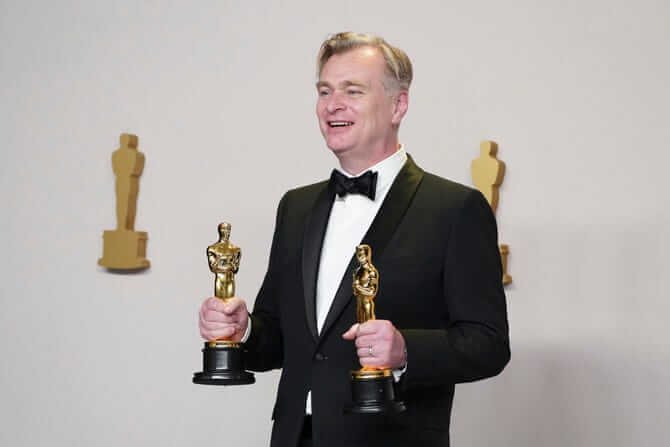
At the 96th Academy Awards in 2024, Oppenheimer won seven Oscars, including Best Picture, Best Director for Christopher Nolan, Best Actor for Cillian Murphy, and Best Supporting Actor for Robert Downey Jr.
The film’s success further established Nolan as a major creative force in contemporary cinema.
Christopher Nolan’s Unique Filmmaking Style
Several defining characteristics distinguish Christopher Nolan from other directors.
Nonlinear Storytelling
Nolan frequently rearranges chronology to shape the audience’s experience. Films such as Memento, The Prestige, and Dunkirk reveal information gradually, encouraging viewers to connect details and reconsider earlier scenes.
Practical Effects and Large-Format Cinematography
Nolan is well known for favoring practical effects when they serve the story. His productions often use real locations, physical sets, and large-format film cameras to create a tangible cinematic experience.
He has also championed IMAX filmmaking, using the format to emphasize scale, detail, and immersion.
Complex Themes and Moral Questions
Nolan’s movies regularly investigate memory, obsession, sacrifice, responsibility, and identity. His characters often face difficult decisions in which personal desires conflict with broader ethical obligations.
Sound and Music
Music and sound design play important roles in shaping tension across Nolan’s films. His collaborations with composers, including Hans Zimmer and Ludwig Göransson, have helped create memorable soundscapes that support the emotional and narrative structure of his movies.
Christopher Nolan’s Awards and Achievements
Christopher Nolan’s career includes significant commercial and critical achievements. His films have received numerous major awards and nominations, while several have become defining releases in their respective genres.
Important milestones include:
- Academy Award for Best Director: Won for Oppenheimer in 2024.
- Academy Award for Best Picture: Won as a producer of Oppenheimer in 2024.
- Academy Award recognition for original screenwriting: Earned nominations for Memento and Inception.
- Major contributions to superhero cinema: The Dark Knight trilogy helped reshape expectations for superhero storytelling.
- Success with original blockbusters: Inception demonstrated the commercial potential of ambitious, original science-fiction filmmaking.
- Recognition for technical innovation: His films have earned awards for cinematography, editing, sound, and visual effects.
These accomplishments reflect his ability to balance creative ambition with broad audience appeal.
Christopher Nolan’s Personal Life
Christopher Nolan is married to film producer Emma Thomas, his longtime creative partner. The couple met while studying at University College London and have collaborated on numerous productions.
Thomas has played a significant role in producing Nolan’s films, helping manage the practical and organizational demands of large-scale filmmaking. Together, they have established a successful creative partnership through their production work.
Nolan generally maintains a private personal life, preferring to keep public attention focused on his films rather than his family. This relative privacy is consistent with his professional reputation for emphasizing the work itself.
Why Christopher Nolan Continues to Influence Cinema
Christopher Nolan’s influence extends beyond individual films. He has demonstrated that audiences will engage with challenging narratives when they are supported by compelling characters, strong visual storytelling, and meaningful emotional stakes.
His commitment to theatrical presentation has also contributed to ongoing discussions about the importance of cinema screens, large-format projection, and the shared experience of watching films in theaters.
At the same time, his career illustrates the value of creative consistency. Across different genres, Nolan repeatedly explores the relationship between human choices and larger systems, whether those systems involve memory, time, political institutions, scientific discovery, or the laws of physics.
His work encourages audiences to participate actively in the storytelling process rather than simply receive information.
Conclusion
Christopher Nolan has established himself as one of the most important filmmakers of his generation through his distinctive storytelling, technical ambition, and willingness to explore complex ideas.
From the independent mystery of Following to the psychological intensity of Memento, the superhero world of The Dark Knight, the dream architecture of Inception, and the historical scope of Oppenheimer, his career demonstrates remarkable creative range.
His films combine entertainment with questions about memory, morality, identity, science, and the human condition. Through practical filmmaking techniques, large-format cinematography, nonlinear narratives, and memorable performances, Nolan continues to influence how ambitious movies are developed and experienced.
His lasting achievement is not simply the creation of successful blockbusters. It is his ability to make challenging ideas accessible through cinema while preserving the mystery, emotion, and spectacle that make movies memorable.